
Buying a cross lease property
Oct 29, 2026
Oct 29, 2026
If cross-leases have left you confused, you’re in good company. They were invented in the 1950s as a workaround to subdivision rules, and they’ve been puzzling buyers ever since. “What is a cross-lease, and what makes one defective?” is one of the most common questions we get, so here’s our guide.
What is a cross-lease?
When you buy a cross-lease, you get two things together:
This means your rights come from three places – the title, the lease and the survey plan of the property (the “flats plan”).
Why do cross-leases exist?
Until the late 1950s, council rules generally allowed only one house per section, and sections couldn’t be subdivided small enough for more. In 1958 the law changed so that leasing part of a building no longer counted as a subdivision. Cross-leases were created as a workaround – a way to give each flat its own title without formally subdividing the land.
From 1971 the same approach could be used for separate buildings on one section, so standalone houses could be cross-leased too. That made cross-leases a cheaper, quicker option for infill housing through the 1970s and 1980s.
The Resource Management Act 1991 ended that advantage. Creating a cross-lease now needs subdivision consent, just like a freehold subdivision, so few new ones are created. But many remain – around 216,000 cross-lease titles in 2016, with almost half of them in Auckland.
The documents that explain what you are buying
The title shows who owns the property and anything registered against it, such as mortgages, rights of way, drainage rights and covenants (rules about how the land can be used).
The title only gives a short description of these. We read the documents behind them so you know what they actually mean for you.
The lease sets out the rules all the owners have agreed to. It usually covers alterations, use of outdoor areas, maintenance, insurance and what happens if there’s a dispute.
Cross-leases usually mention a token rent (often 10 cents a year), sometimes payable only if asked for. In practice it is rarely asked for, but check the amount and terms in your own lease.
The flats plan is a survey plan. It shows the outline of each home and may also show garages, other buildings, shared areas such as the driveway, and areas set aside for one owner’s private use (called “exclusive-use” or “restricted-use” areas).
A private-use area isn’t a separate section you own outright. Your rights over it come from the lease. Also note that a fence doesn’t prove where your legal rights start and stop – only the documents do.
What if the flats plan does not match the property?
This is the most common cross-lease problem. Your lease covers your home as drawn on the flats plan. If the home has since been extended outwards or upwards and the plan was never updated, the extra part isn’t covered by your lease. That likely means it is a defective title.
Things to look out for include:
Not every difference is a problem
A freestanding building in your private-use area, such as a garden shed, may not affect the title at all, and the same can apply if one is removed. Attached decks, porches and carports are a grey area – see the quick self-check at the top of this guide. Either way, we check each one against the plan and the lease rather than assuming.
An example
The flats plan shows a single carport beside the home. Since then, the carport has been enclosed and turned into a garage with a sleepout at the back.
The garage now sits outside the outline of the home on the plan, so it isn’t covered by the lease and the title is defective. Our questions would be – did the neighbours consent? Did council approve the building work? Will the vendor fix the plan before settlement, or reduce the price? And will your bank lend in the meantime?
Flow chart – is it a problem?
Here is a simplified flow chart to follow. You should always have this checked properly with a lawyer.
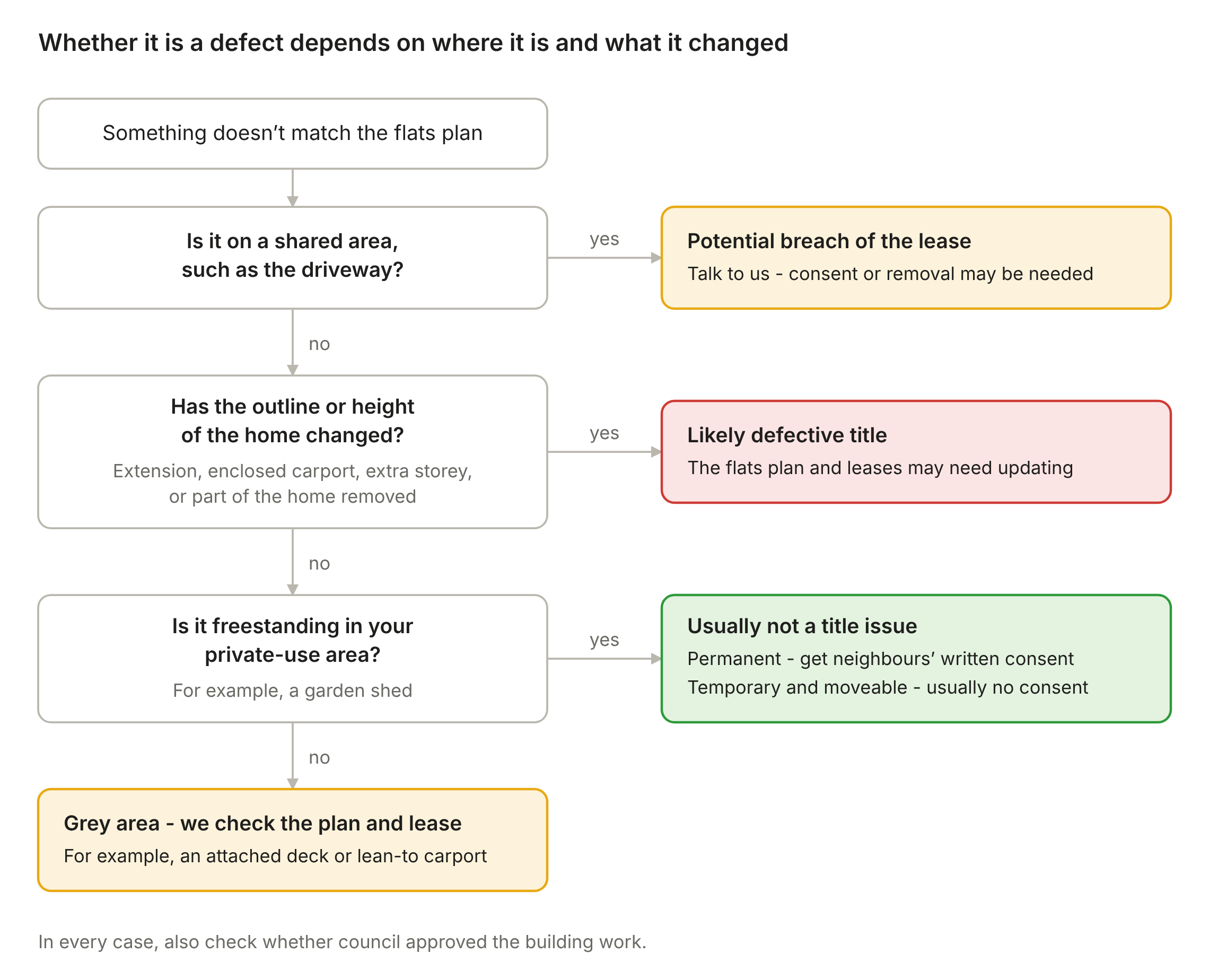
Whatever the answer, also check whether council approved the building work – that’s a separate question (see below).
Why a defective title matters
How a defective title is fixed
A signed consent from your neighbours deals with whether the work was allowed under the lease. It doesn’t change the plan, so it doesn’t fix a defective title on its own.
Fixing the title usually means:
It takes time, costs money and everyone needs to cooperate.
Sometimes a buyer and their bank decide to go ahead without the title being fully fixed. That is accepting a risk – the defect is still there.
If the vendor agrees to fix it
The agreement should say exactly what will be done, who pays, and by when. Sometimes part of the price is held back until the work is done (a “retention”). If so, the agreement needs to say when that money is released and what happens if the vendor doesn’t follow through. Holding back money doesn’t fix the problem by itself.
What this means for you – compare the plan with the property early, and tell us about anything that looks different. Most issues can be solved, but the time to sort them out is before you’re committed.
Alterations and your neighbours’ consent
Most cross-leases say you need your neighbours’ written consent before altering your home or building anything new, often including work in your private-use area. The exact wording of your lease matters.
Many leases add that consent “shall not be unreasonably withheld”. That doesn’t mean your neighbours have to say yes, but it also doesn’t give one neighbour an automatic veto.
Checking past work
When the home has been altered before, we check:
Will an old consent protect you?
Not always. Even a consent signed as a deed, or one that says it binds future owners, won’t necessarily bind everyone who buys the neighbouring home later. We check the lease and the consent to see whether anything more is needed.
What if one person owned all the homes?
If the same person owned every home on the site when the work was done, that can help – they were effectively consenting to themselves. But it isn’t automatic proof that everything was in order. We check the ownership history and the timing, and it still doesn’t fix a flats plan that is out of date.
What this means for you – get consents in writing, have us check them, and talk to your neighbours early about any renovations you’re planning.
Council approval is a separate question
There are three different questions, and a property can pass one and fail another.
| Question | What it’s about |
| Is the altered home covered by the lease? | The flats plan and title |
| Did the neighbours consent? | The rules in the lease |
| Did council approve the building work? | Building consent and council sign-off |
For example, a council-approved extension can still be missing from the flats plan. And an up-to-date flats plan doesn’t prove council approved the work.
We review the LIM (the council’s report on the property) and the council’s property file. We also recommend a building inspection.
What if there’s no building consent?
Some minor work doesn’t need a building consent at all – it depends on the type of work and the rules at the time it was done.
Where consent was needed but not obtained, options can include further investigation, repairs, or applying to council for a Certificate of Acceptance. This is council confirming the work meets the building rules as far as it can tell from what it can inspect. It isn’t the same as a building consent or a code compliance certificate (council’s final sign-off on consented work), and it may only cover the parts council could see.
A report from a builder or engineer can be useful evidence, but it isn’t council approval and doesn’t make unconsented work legal.
What this means for you – a sound title and a sound building are two separate checks. You should check both.
Other things to check
Shared areas and costs
The lease may say who looks after the driveway, drains, fences and other shared areas. Ask the vendor about current arrangements, any unpaid costs and any disputes with the neighbours.
Insurance
Check what the lease says about insurance and rebuilding, especially if your home is joined to your neighbour’s. Sometimes each owner insures their own home, and sometimes joint cover is needed.
Converting to freehold
It’s sometimes possible to convert a cross-lease into separate freehold titles, especially if a new flats plan is needed anyway. This usually needs every owner to agree, a surveyor, council approval and sign-off from each owner’s bank. Auckland Council has more information on cross-lease properties.
Conversion isn’t guaranteed, and even after converting, shared driveways, drains and other rules between neighbours may continue.
How Nu Legal can help
We can review the title, lease and flats plan, explain the legal issues and work with you to identify any further investigations required.
Where appropriate, we can negotiate contractual protections, review neighbour consents and coordinate with the vendor’s lawyer and your lender. Physical condition and survey questions may also require input from a building professional or surveyor.
If you are considering an auction purchase, contact us early to discuss a pre-auction review.
Contact Nu Legal on 09 929 1170 or lawyers@nulegal.co.nz.
Last reviewed October 2026. This article is general information only and is not legal advice.